
Bicopter vs. Quadcopter: What the Vcopter Falcon Mini Teaches Us About Drone Design Trade-Offs
By RobotWorld·8/11/2026
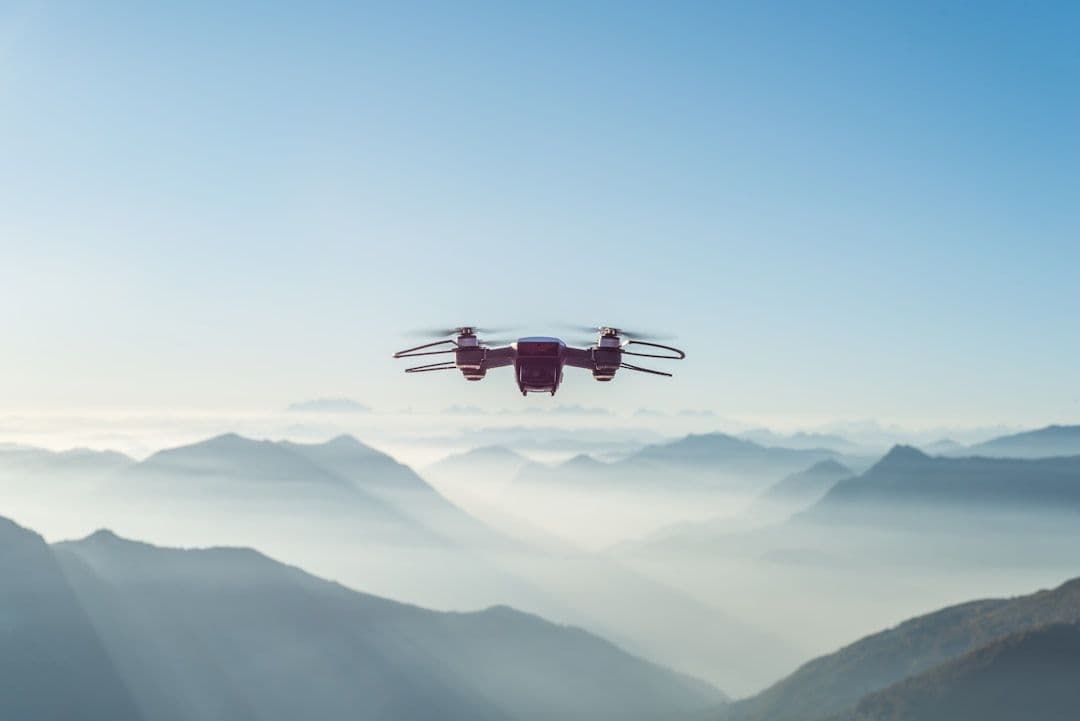
When Two Rotors Aren't Better Than Four
Consumer drones are a surprisingly conservative product category. Despite years of innovation in batteries, sensors, and autonomous flight software, the vast majority of personal and professional drones share a single layout: four rotors arranged in a flat X or H configuration. That's why the Vcopter Falcon Mini from Zero Zero Robotics attracted so much attention when it was announced. As a bicopter — a drone that flies on just two rotors — it looks unlike almost anything else on the market. But a closer look at the design illustrates exactly why the quadcopter formula became so dominant in the first place.
What Is a Bicopter, Exactly?
A standard quadcopter generates lift, stability, and directional control by independently varying the speed of its four motors. Because the rotors spin in opposing pairs, the drone can yaw, pitch, and roll without any moving mechanical parts beyond the motors themselves. It's an elegantly simple system that's easy to manufacture reliably and cheap to repair when something goes wrong.
A bicopter takes a very different approach. With only two rotors, you can't use differential motor speed alone to achieve full three-axis control. Instead, the rotors are typically mounted on tilting mechanisms — they physically pivot to redirect thrust. The Falcon Mini uses this principle: its two large rotors tilt in concert or independently to steer the aircraft, much like the cyclic and collective controls of a helicopter.
The theoretical appeal is real. Fewer, larger rotors can be more aerodynamically efficient than many small ones. Large rotors move a bigger mass of air per revolution, which translates to better energy efficiency in hover — the flight mode consumer drones spend most of their time in. A two-rotor layout can also produce a sleeker, more compact folded form factor, which matters for portability.
Where the Design Gets Complicated
The problem is that mechanical complexity has a cost. Tilting rotor mounts introduce additional servo mechanisms, pivot points, and linkages that all need to be precisely calibrated and that can wear or fail over time. Quadcopters sidestep this entirely — their control surfaces are purely electronic, with no moving parts beyond the spinning motors.
Stability is another challenge. Quadcopters, particularly modern ones with advanced flight controllers and inertial measurement units (IMUs), have become extraordinarily stable platforms. They correct for wind gusts and turbulence almost instantly at the software level. A bicopter's control authority depends on how quickly its tilting mechanisms can respond, adding a physical latency that pure electronic control doesn't face.
For a camera drone, where smooth, predictable movement is everything, these trade-offs matter enormously. Any mechanical slop or vibration in the rotor tilt mechanism will show up directly in footage quality. Quadcopters with well-tuned three-axis gimbals have a significant head start here.
The Value Equation in Consumer Drones
Reviews of the Falcon Mini note that while it is genuinely novel and fun to examine as an engineering object, the real-world flight experience and image quality don't justify the premium over comparably priced quadcopters. This isn't a knock on Zero Zero Robotics' ingenuity — it's a reflection of how mature and refined the quadcopter category has become.
Consider what today's sub-250 g quadcopters deliver: obstacle sensing in multiple directions, subject-tracking AI, 4K stabilized video, and return-to-home automation — all in platforms that weigh less than a can of soda. The DJI Mini 4 Pro, for instance, packs omnidirectional obstacle avoidance and a large 1/1.3-inch sensor into the sub-250 g weight class that keeps it out of the most burdensome regulatory categories in many countries. The DJI Mini 4K offers a similarly compact, travel-friendly package with a stabilized 4K camera at a lower entry price. These products represent over a decade of iterative refinement on a fundamentally sound aerodynamic formula.
Zero Zero Robotics' own HOVERAir quadcopter line has been widely praised as an approachable, well-executed take on the self-flying camera concept — which makes the Falcon Mini's positioning even more puzzling from a commercial standpoint. When your own product lineup already offers a more practical alternative, the novelty drone faces an uphill battle.
Why Novel Drone Designs Still Matter
None of this means bicopters or other unconventional layouts are dead ends. There are genuine use cases where alternative rotor configurations shine:
- Fixed-wing hybrids (VTOL drones) use fewer rotors during cruise flight to achieve far greater range and endurance than pure multicopters — a design increasingly common in commercial surveying and logistics.
- Coaxial designs (two rotors on a single axis, spinning in opposite directions) trade efficiency for compactness and are found in some indoor inspection robots.
- Single-rotor helicopters remain the gold standard for very long endurance missions where hover efficiency trumps all else.
Each of these represents a legitimate engineering trade-off. The lesson from the Falcon Mini isn't that experimentation is foolish — it's that novelty needs to solve a real problem for a defined user to succeed in a market where the baseline is already very capable.
The Takeaway for Drone Buyers
If you're in the market for a consumer or prosumer drone today, the bicopter concept is fascinating to follow as an engineering exercise, but the performance-per-dollar argument still firmly favors the quadcopter. Whether you're shooting travel content, inspecting infrastructure, or getting into FPV flying, established platforms offer proven reliability, deep ecosystems of accessories and software, and regulatory clarity that novel form factors can't yet match.
Curious about which drone fits your specific workflow? Browse our drone range — our team is happy to help you find the right platform for your needs.
References
This article was drafted with AI assistance and reviewed before publishing.
Related reading
- DronesBeyond GPS: How Elsight's New Positioning Tech Could Transform Drone Navigation
- DronesEnd of an Era: The DJI Phantom 4 Pro V2.0 Is Being Retired — and What It Means for Aerial Photography
- DronesHow Faster FAA Airspace Clearance Is Changing the Way Emergency Drones Get Deployed
- DronesDJI Mini 5 Pro Fly More Combo: What the Sub-$1,000 Deal Actually Gets You